
Tonight, in an hour
Don't start with ravioli. Start with cavatelli — two ingredients, no eggs, no rolling pin, and the gnocchi board does the work. The confidence transfers to everything else in this book.
Budget about forty minutes of actual work and around an hour and a quarter from flour to plate the first time. Half an hour of that is the dough resting on its own, which is when you make the sauce, lay the table and pour something. You get quicker fast — the second time is closer to forty-five minutes end to end, and the shaping is the part that speeds up.
- Weigh 200 g semolina flour onto a clean worktop. Make a well in the middle.
- Pour in 100 g warm water and a large pinch of salt. Bring it together with a fork, then with your hands.
- Knead 8 minutes. It will feel stiff and a bit shaggy at first. Keep going — it smooths out suddenly, around minute six.
- Wrap it and leave it on the counter 30 minutes. Put the water on to boil at the 25-minute mark.
- Cut off a piece, roll it into a rope the width of your finger, cut into thumbnail-sized pieces.
- Press each piece down the ridged board with your thumb so it curls. Drop the finished ones onto a semolina-dusted tray.
- Boil 4–6 minutes — taste one at four — then finish in a pan with sauce and a splash of the pasta water.
Short on time tonight?
Make the dough this evening and refrigerate it wrapped. Tomorrow it needs no rest — take it out twenty minutes ahead and you are shaping straight away, which puts dinner about twenty-five minutes from the fridge.
The feel test
Correct dough is firmer than bread dough — press it and it should feel like the flesh of your palm below the thumb, not like an earlobe. Sticky means more flour; cracking means a teaspoon more water.
The three doughs
Every shape in this book comes from one of three doughs. Learn them as ratios rather than recipes and you will never need to look them up again. Weigh, don't measure by cup — flour compacts, and a 15 % error is the difference between silk and cardboard.
| Dough | Ratio | Per person | Use it for |
|---|---|---|---|
| Semolina & waterSouthern Italy, eggless | 100 g semola 50 g warm water 2 g salt |
100 g flour | Cavatelli, orecchiette, busiate, garganelli, anything shaped on the board |
| Egg sfogliaEmilia-Romagna | 100 g "00" flour 1 large egg + 5 g water |
100 g flour 1 egg |
Tagliatelle, pappardelle, ravioli, lasagne sheets |
| Everyday blendThe forgiving one | 70 g "00" + 30 g semola 1 large egg |
100 g flour 1 egg |
Any egg shape, when you want a sturdier sheet that fights the pin less |
On flour
Semola rimacinata is twice-milled durum wheat — pale gold, slightly gritty, and the reason southern pasta holds its shape without egg. "00" is a grind, not a protein level: it is finely milled soft wheat that makes a tender, extensible sheet. Plain all-purpose flour works in the egg doughs; it gives a slightly chewier, less silky result, which is not a tragedy.
Egg size genuinely matters here, because the egg is the entire liquid, and it is the one place American and Italian recipes quietly disagree. A US large egg is 50 g out of the shell; the European large egg the classic ratio assumes is nearer 58 g. So with US eggs, 100 g of flour per egg runs dry — add a teaspoon of water per egg, and be ready to add a second. Work to the feel test, not the number.
Dust with semolina, never flour
Keep a bowl of semola beside you for dusting the board, the tray and the finished shapes. It is coarse, so it sits on the surface and keeps strands apart instead of being absorbed. All-purpose flour dissolves into the dough, turns gluey, and clouds your cooking water into paste.
Without gluten, without egg
Two requests that sound similar and are not. Cooking without egg is easy — the oldest pasta in Italy never had any. Cooking without gluten is a different craft, and pretending otherwise wastes your flour.
Egg-free is not a compromise
The semolina-and-water dough in the last chapter contains no animal product at all. It is not a substitute for "real" pasta — it is the traditional pasta of southern Italy, and it is what the ridged board in your set was designed for. Every shape below is naturally vegan.
| Already egg-free | Dough | Notes |
|---|---|---|
| Cavatelli, capunti, foglie d'ulivo | 100 g semola : 50 g water | The board's home territory |
| Orecchiette, busiate | 100 g semola : 50 g water | Hand-shaped, no tools needed |
| Sheets for ravioli and lasagne | 100 g semola : 52 g water : 3 g oil | The oil buys back some pliability |
| Potato gnocchi | Omit the yolk, add 20 g flour | More delicate — test-boil one first |
For egg-free sheets, rest the dough a full hour rather than thirty minutes and roll it slightly thicker than you would an egg sfoglia — about 1.5 mm. It is less extensible, so it will tell you when you have pushed it far enough by tearing at the edge. Seal with water, exactly as you would otherwise.
Gluten-free is a different craft
Semolina is wheat
Semola rimacinata, "00", durum, spelt and farro all contain gluten. If you are cooking for someone coeliac, none of the doughs in Chapter Two are safe, regardless of how they are labelled in the shop.
Gluten is what lets a sheet stretch without tearing. Remove it and you have starch and water, which makes a paste, not a dough. So you rebuild the missing structure from three directions at once: a binder that mimics elasticity, extra egg protein for strength, and hot water to gelatinise some of the starch before it ever reaches the pan.
A dough that works
- Fine white rice flour120 g
- Tapioca starch50 g
- Potato starch30 g
- Xanthan gum5 g
- Fine salt3 g
- Large eggs2 + 1 yolk
- Olive oil10 g
- Hot wateras needed
Whisk the dry ingredients together thoroughly — the xanthan must be evenly dispersed or it clumps into slippery beads. Add the eggs and oil, then hot water a tablespoon at a time until it comes together as a soft, slightly tacky dough. Knead only two or three minutes; there is no gluten to develop and overworking does nothing. Rest it 30 minutes wrapped, which matters more here than in wheat dough, because the starches need that time to absorb water.
To go gluten-free and egg-free, swap the xanthan for 12 g of whole psyllium husk soaked in 150 g hot water for ten minutes first. The psyllium gel does the work both the gluten and the eggs were doing. Expect a softer dough and stay with the pressed shapes below.
Handling it
- Roll between two sheets of baking parchment. Gluten-free dough cannot take direct contact with a pin or a dusted board — it tears and sticks at the same time.
- Cut through, don't fold. Never fold the sheet to cut ribbons; it will not unfold. Run the cutter wheel across the flat sheet and lift the strands away individually.
- Work fast and keep it covered. It dries out several times quicker than wheat dough and cracks rather than skinning.
Which shapes to attempt
Start where the dough is thick and pressed rather than thin and stretched — which happens to be exactly what your board is for. Cavatelli and potato gnocchi are the two best gluten-free shapes in this book, and gnocchi barely change at all, since they are mostly potato. Leave thin ribbons and ravioli until you have made the dough twice; both demand a sheet that gluten-free dough gives up reluctantly.
Cooking
Gluten-free pasta sheds far more starch, so use the full four litres and do not crowd the pot. It cooks in 2–4 minutes and goes from firm to collapsing quickly, so start tasting at two. The cooking water is thick enough that a tablespoon or two is plenty when you finish in the pan.
Wood cannot be made gluten-free
These tools are porous and unsealed. Once a board, pin or rack has touched wheat dough, flour is trapped in the grain and no amount of washing removes it — and washing is exactly what you must not do to them. If you are cooking for someone coeliac rather than gluten-avoiding by choice, the set has to be dedicated gluten-free from new. Keep a second set, and label it.
Knead and rest
Two thirds of pasta failures are a kneading problem or a resting problem, and both are free to fix.
The well, or the bowl
Traditionally you tip the flour onto the counter, make a crater, and beat the eggs in the middle with a fork, pulling flour in from the inner wall until it stops running. It works, it is satisfying, and it leaks if your wall is thin. A bowl is not cheating — mix to a shaggy mass in the bowl, then turn out onto the counter to knead. The finished dough is identical.
Kneading
Push the heel of your hand into the dough, fold it back over itself, rotate a quarter turn, repeat. Eight to ten minutes for egg dough, a little longer for semolina. You are looking for a surface that has gone from rough to satin, and a ball that springs back slowly when pressed. Pasta dough is stiff — this is real work, and the first few minutes feel wrong.
Resting
Wrap the ball tightly and leave it at room temperature for 30 minutes minimum, up to two hours. Two things happen: the water finishes hydrating the flour, and the gluten you just built relaxes. Skip it and the sheet will snap back every time you roll it, and you will lose the fight.
Never leave dough uncovered
A skin forms in minutes, and it will not roll out — it shows up later as dry flecks and tears in your sheet. Keep every piece you are not actively working under an upturned bowl or wrap.
Rolling without a machine
This is the one skill in the book that takes practice. The trick is that you are not pressing the dough thinner — you are stretching it over the pin.
- Cut the rested dough into quarters. Work one at a time; cover the rest.
- Flatten a quarter into a disc with your palm. Dust lightly underneath.
- Roll from the centre outward — always centre to edge, never back and forth across the whole sheet. Give it a quarter turn after every two or three passes so it stays roughly round and even.
- Once it is too wide to push, roll the far edge loosely around the pin, then push the pin away from you while stretching the sheet gently outward with your palms. Unroll, turn 90°, repeat.
- Stop when it is the thickness you need. Let the sheet dry 5–10 minutes before cutting — you want the surface leathery but not brittle. Too wet and the ribbons stick back together; too dry and the edges crack as you cut.
| You are making | Thickness | The test |
|---|---|---|
| Ravioli, tagliolini | ≈ 1 mm | You can see the shadow of your hand through it |
| Tagliatelle, fettuccine | 1–1.5 mm | Opaque, but flops over the pin without cracking |
| Pappardelle, lasagne | 1.5–2 mm | Holds a firm edge when lifted |
| Filled shapes with wet fillings | 1.5 mm | Slightly thicker; thin sheets burst |
Cutting ribbons
Once the sheet is leathery but not brittle, dust it generously with semola, then run the ribbed pin down its length. Its blades cut the sheet into even straight ribbons in one pass — this is what that pin is for, and it is quicker and more even than doing it by hand.
For a crimped edge, use the fluted wheel instead, running it along a ruler or the edge of the dough cutter — 2 cm wide for pappardelle. And if you would rather cut by knife, fold the sheet over on itself three or four times into a flat roll and cut across at 6–7 mm.
However you cut them, lift the pile with your fingers and shake it loose immediately or it welds together. Nest into loose coils on a semolina-dusted tray.
Your nine tools
Every piece in the set does one job well. Here is what each is actually for — and, more usefully, what people typically get wrong with it.
The gnocchi board
The heart of the set — a ridged paddle with a handle. The grooves do two jobs: they curl a flat piece of dough into a hollow shape, and they cut channels that hold sauce. Gnocchi, cavatelli, capunti, garganelli. Press firmly; timid pressure gives a flat scrap with faint lines.
The pasta drying rack
A central post on a round base with arms radiating from the top, like a small tree. Hang nests and ribbons on the arms so air moves around them and they don't weld together. It unscrews for storage — take it apart rather than leaving it standing in a humid kitchen.
The rolling pin
Your main sheet tool. Straight, untapered and unhandled by design: you want to feel the dough through the wood and use the full length. Never wash it — scrape and wipe.
The ribbed rolling pin
This one cuts. Run it the length of a rested, surface-dried sheet and its blades slice the whole thing into even straight ribbons in a single pass — faster than folding and cutting by knife, and far more even. Press firmly and go slowly enough to cut all the way through.
The thin rolling pin
The narrower of the two plain pins, and it earns its keep as a shaping tool rather than a sheet tool. Lay a square of sheet on the gnocchi board at 45°, roll it around this pin, press down the ridges, slide it off — that is garganelli. It also hollows cavatelli if you would rather not use your thumb.
The square ravioli stamp
Wooden handle, fluted steel edge. Press straight down through both sheets on a lightly floured surface, then twist a few degrees to cut clean. Push the ravioli out from the back with your thumb.
The round ravioli stamp
The same tool with a circular head, for tortelli and any round filled shape. Round wastes more dough than square — keep the offcuts, re-roll them once, and cut them into stracci.
The wheel cutter
A toothed disc on a handle. Crimps and seals in one pass and gives the sawtooth edge that catches sauce. Use it for square ravioli, lasagne edges, pappardelle, and for cutting stracci from offcuts.
The dough cutter
Steel blade, wooden grip — a bench scraper by any other name. Divides the dough, lifts sticky sheets off the counter without tearing, and — most importantly — cleans the worktop. Dried dough comes off with a scraper and no water.
Matching this to your box
Gnocchi board · thin rolling pin · rolling pin · ribbed rolling pin · two ravioli stamps, round and square · dough cutter · wheel cutter · pasta drying rack. Match the drawing to the shape in your hand and read that entry.
Shaping
Ten shapes, nine tools
Between them these use every tool in the set. Four are pressed on the ridged board, two are shaped on a bare worktop with your fingers and a knife, two are cut with the ravioli stamps, and the last two are rolled with the pins — one cut straight, one with the fluted wheel.
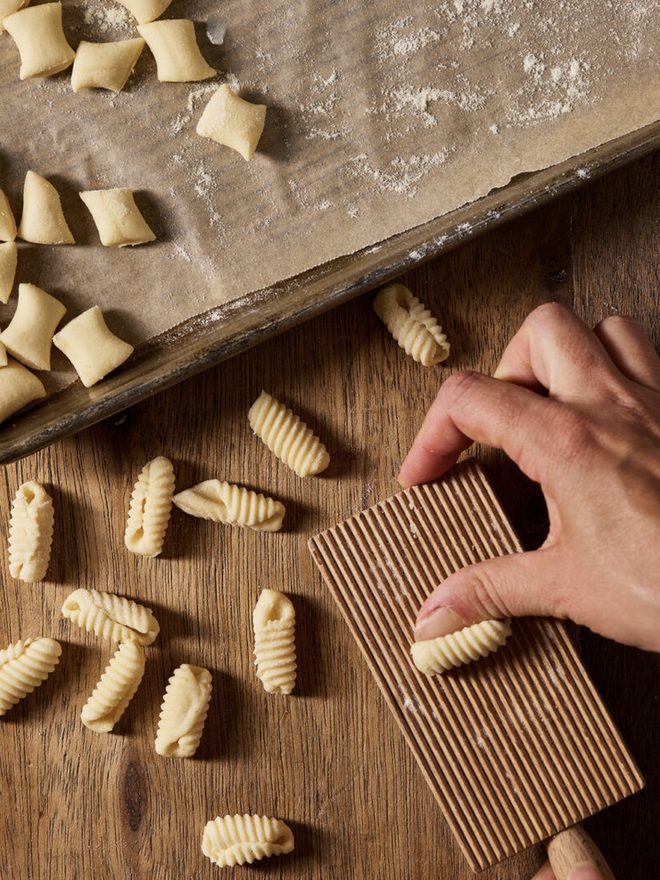
Cavatelli
SemolinaFinger-width rope, cut into 2 cm pieces, pressed and dragged with the thumb.
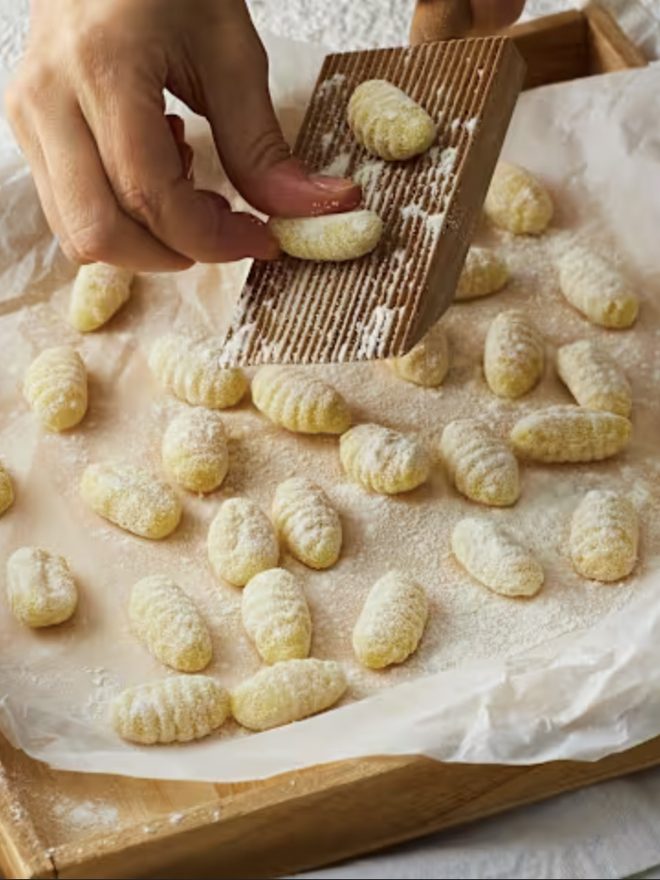
Gnocchi
PotatoThe same drag with lighter pressure — potato dough tears.
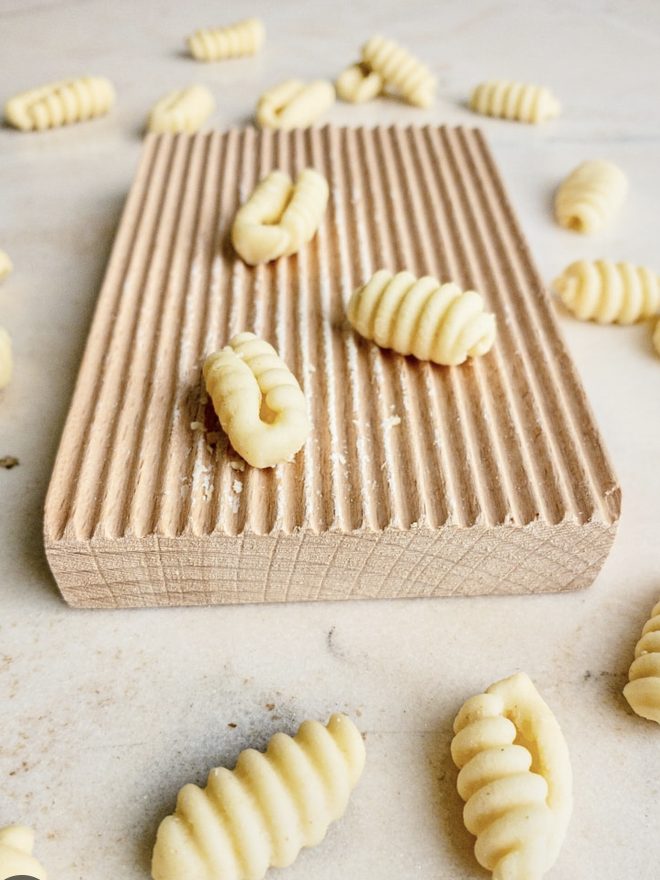
Gnocchetti
SemolinaCavatelli at half the size, rolled rather than dragged.
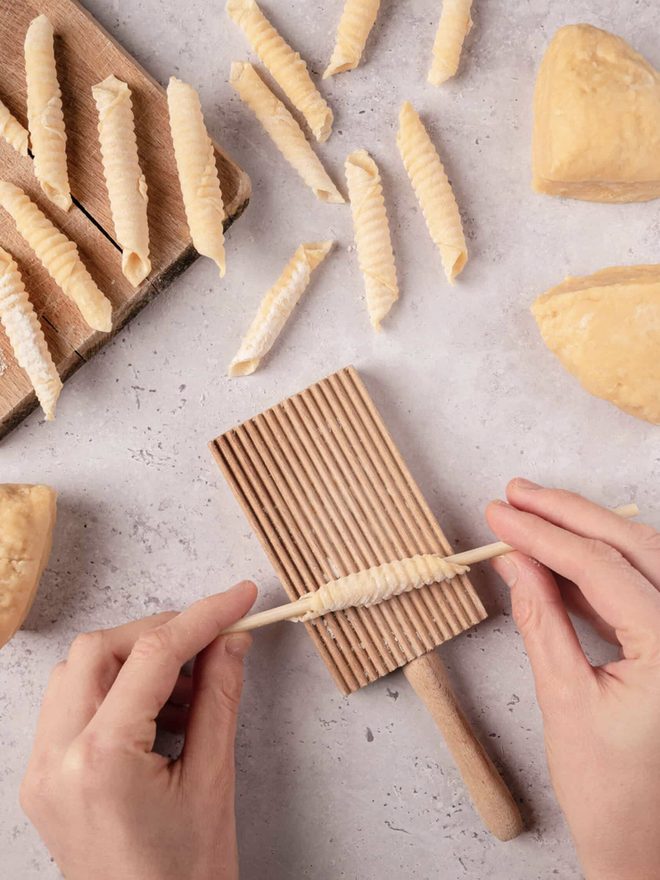
Garganelli
EggA 4 cm square laid at 45°, rolled on the thin pin, pressed once.
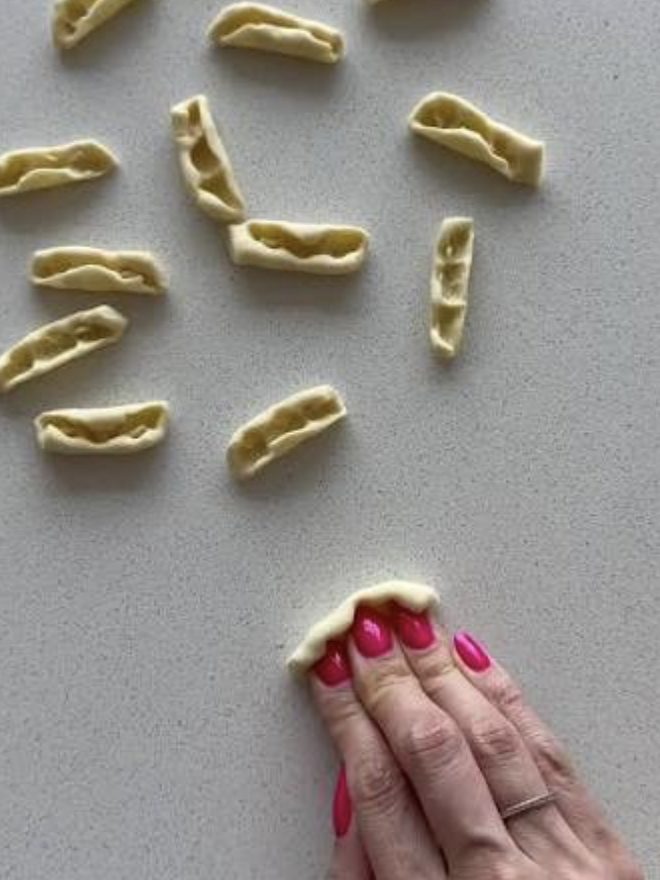
Capunti
SemolinaA flattened strip on a worktop: press three fingers in and drag towards you so it opens into a hollow pod.
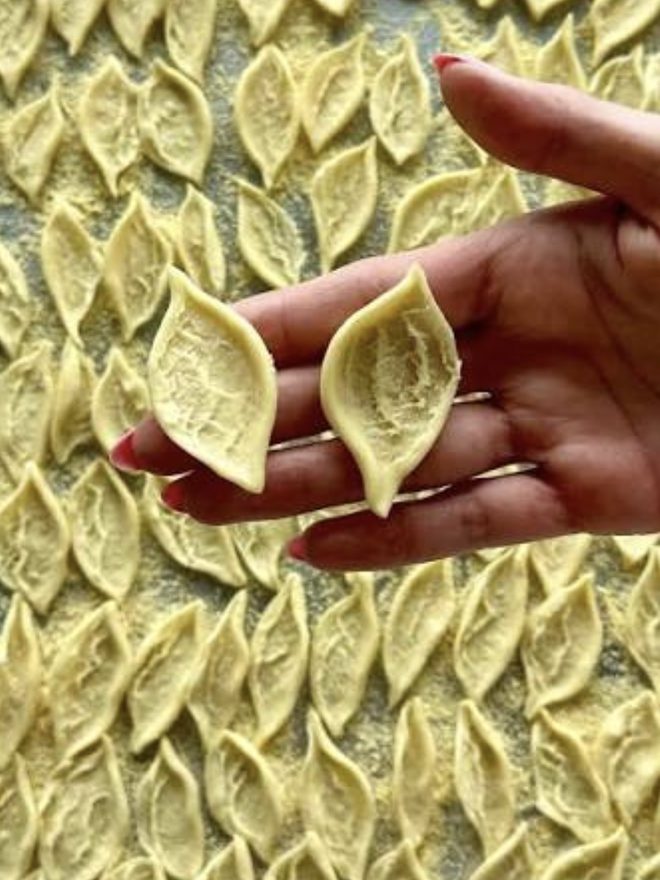
Foglie d'ulivo
SemolinaCut the rope into 3 cm pieces, roll each between your palms into a thin strip, hold one end with two fingers and drag the flat of a knife along it.
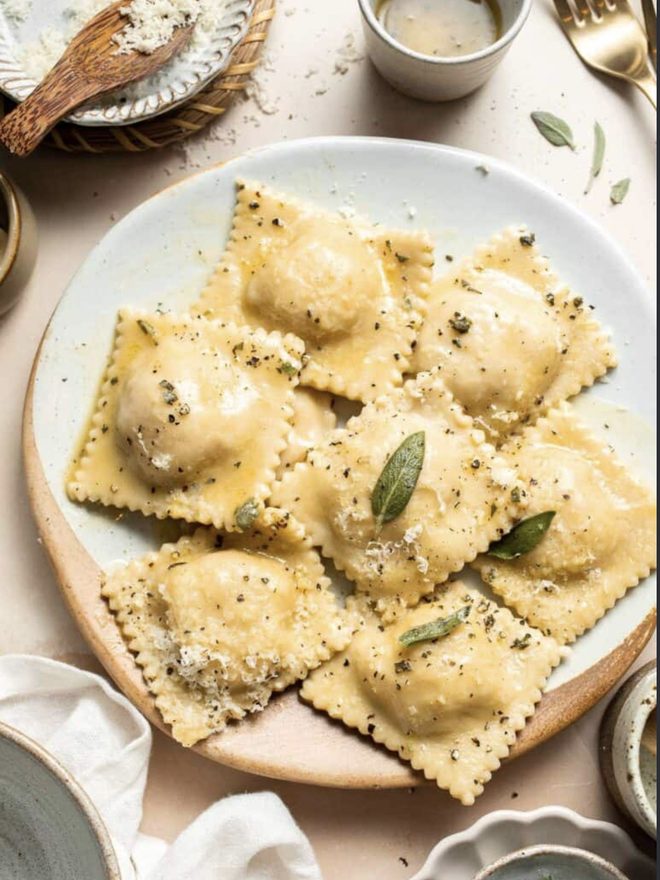
Square ravioli
EggTwo sheets, filling spaced between them, pressed and cut with the square stamp.
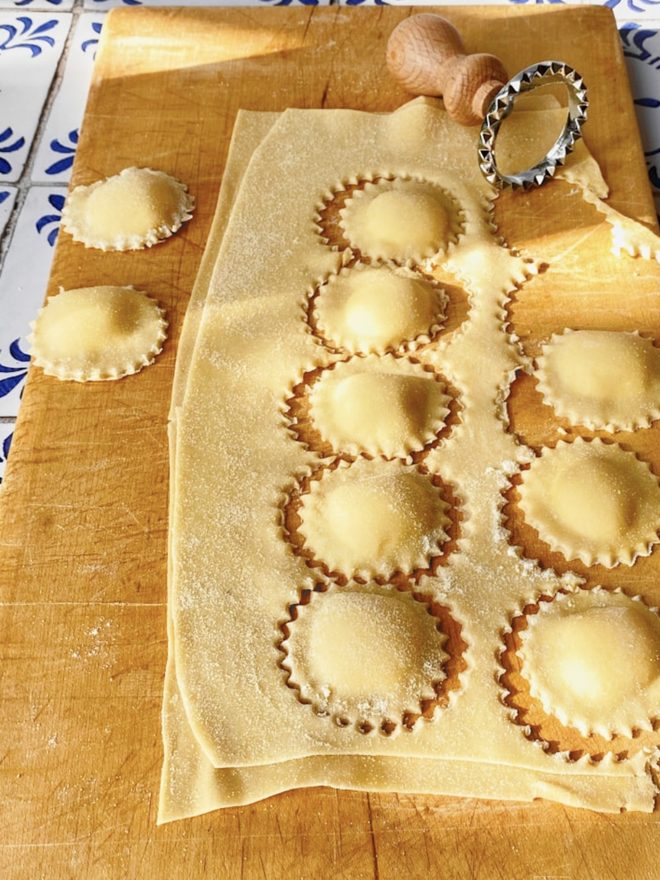
Round ravioli
EggThe same, cut with the round stamp. Round wastes more dough — re-roll the offcuts once.
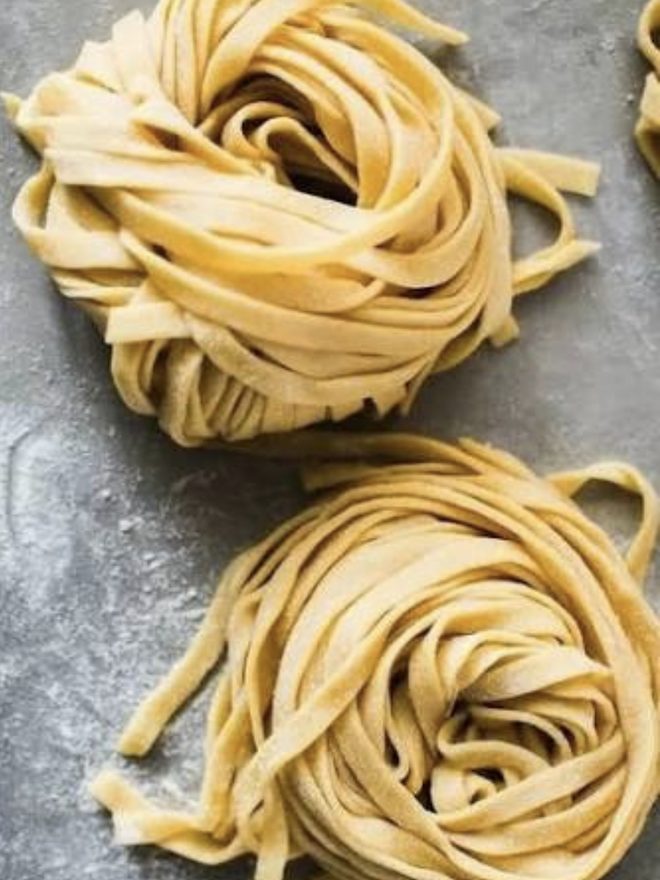
Tagliatelle
EggRoll a sheet and let it dry 5–10 minutes, until the surface feels leathery but not brittle. Then run the ribbed pin down it — the blades cut straight ribbons in one pass.
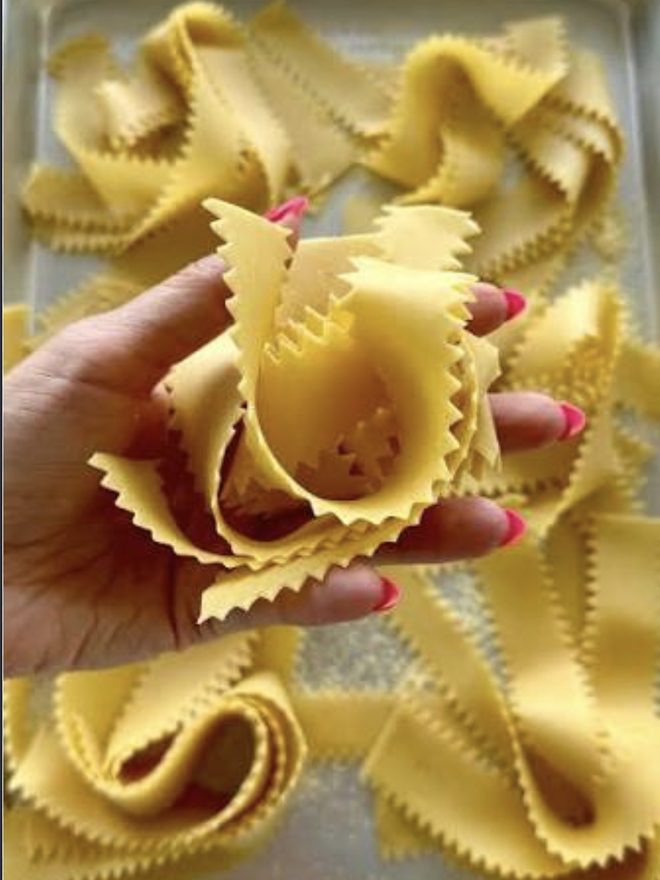
Pappardelle
EggThe same sheet, cut at 2 cm with the fluted wheel for a crimped edge that holds more sauce.
Filled pasta that survives the pot
Ravioli fail for exactly three reasons, in this order of frequency: a wet filling, trapped air, and a weak seal.
- Dry the filling. Ricotta must drain in a sieve overnight in the fridge — supermarket tubs hold a startling amount of whey. Squeeze cooked spinach in a towel until you are certain it is dry, then squeeze again.
- Portion small. A rounded teaspoon — about 8 g — for a 5 cm ravioli, or 15 g for a 7 cm one. Overfilling is the most common beginner error and leaves no room to seal.
- Brush water, not egg. A damp fingertip or brush around each mound on the bottom sheet only. Egg wash makes the seam thick and rubbery.
- Press the air out from the mound outward. Lay the top sheet down and cup your hands around each mound, pushing air toward the edges before you cut. Trapped air expands in boiling water and splits the seam.
- Cut, then check. Pinch the whole rim of each finished ravioli between finger and thumb. Any that feels puffy, open and reseal it.
Rest finished ravioli in a single layer on a semolina-dusted tray. Never stack them — they fuse, and pulling them apart tears the seam you just made.
Making pasta with children
A crank machine is a one-person job — someone turns the handle and everyone else watches. Hand tools are not. Give four people a lump of dough each and they can all work at the same time, which is most of the reason this set ends up on the table on a Sunday rather than in a cupboard.
Two rules before anyone starts
Nobody eats the raw dough. Flour is a raw agricultural product — E. coli and
salmonella survive in it and are killed only by cooking. Public health agencies advise specifically
against letting children eat or play with uncooked dough. Hands washed afterwards, no tasting.
The cutters are adult tools. The dough cutter and the wheel cutter have real metal
edges. The gnocchi board, the three pins and the ravioli stamps have none — those are the ones to
hand over.
Jobs by age
| Age | The job | Why it works |
|---|---|---|
| 2–4 | Pressing cavatelli down the board with a thumb | One movement, no tool to hold, and the shape appears instantly |
| 4–7 | Rolling ropes, cutting them with a table knife, dusting trays with semolina | Rolling a rope is the same motion as a plasticine snake |
| 7–10 | Rolling sheets with a pin, spooning filling, sealing ravioli | Enough patience for the pressing-out-air step, which is the one that matters |
| 10+ | The wheel cutter and the dough cutter, supervised | Metal edges, so it is a supervised promotion rather than a free-for-all |
What makes it go well
- Make the dough before they arrive at the table. Kneading for eight minutes is dull for a child and the resting half hour is worse. Start them at the shaping, which is the fun part.
- Give everyone their own lump. Sharing one piece of dough produces exactly the argument you would expect.
- Cook the ugly ones. A child who watches their misshapen cavatelli get scraped into the bin does not come back next week. They taste the same.
- Semolina on everything. Trays, hands, board. It is the difference between a tray of separate shapes and one large communal lump.
- Stop before they do. Twenty minutes of shaping is a good session. Have a plan for the rest of the dough — the fridge keeps it a day.
Drying and keeping
There are two different kinds of drying, and confusing them is what ruins a batch.
Surface drying, before you cook
15 to 30 minutes on the rack or a dusted tray. The outside goes from tacky to dry to the touch while the inside stays soft. This is what stops ribbons from welding into a brick, and it is worth doing every single time.
Drying through, for storage
12 to 24 hours, until a strand snaps cleanly instead of bending. Hang ribbons on the rack in a single layer somewhere with moving air and no direct sun. Dry only in a dry kitchen — in humid weather pasta can sour before it dries.
Only dry eggless pasta at room temperature
Semolina-and-water pasta dries and stores safely on a shelf. Egg pasta should not be — commercially dried egg pasta is dried under controlled heat and humidity that a kitchen counter cannot reproduce. Freeze egg pasta instead; it keeps better and tastes fresher.
| Keeping it | How | How long |
|---|---|---|
| Fresh, in the fridge | Dusted, loosely covered tray | 1–2 days |
| Frozen ribbons | Nests frozen on a tray, then bagged | 2 months |
| Frozen filled pasta | Single layer on a tray until solid, then bagged | 1 month |
| Dried semolina pasta | Snapped-dry, airtight jar | 4 weeks |
Cook frozen pasta straight from the freezer and add about a minute. Never thaw it first — thawed ravioli weep, stick to the tray and tear.
Cooking and finishing
Fresh pasta cooks in a fraction of the time dried pasta needs, and the last thirty seconds in the pan matter more than anything you did to the dough.
| Shape | Boiling time | Doneness |
|---|---|---|
| Thin ribbons, tagliolini | 60–90 sec | Tender with a faint bite |
| Tagliatelle, pappardelle | 2–3 min | No raw flour taste at the centre |
| Cavatelli, capunti | 4–6 min | Chewy, no chalky core — taste one |
| Garganelli | 3–4 min | Tender at the rolled seam |
| Ravioli | 3–4 min | Sheet translucent at the seam |
| Potato gnocchi | 90 sec after floating | Float is the signal to start tasting |
The water
Use 4 litres of water and 7–10 g of salt per litre for 500 g of pasta. "As salty as the sea" is a nice line and roughly three times too much salt. Fresh pasta needs a big pot far more than dried does — it sheds starch fast, and a crowded pot turns to glue.
Save a mug of the water
Before you drain, dip out about 250 ml. Starchy pasta water is what turns fat and cheese into a sauce that clings instead of sliding off. It is the most useful ingredient in the kitchen and it is free.
Finishing in the pan
Never sauce pasta in the bowl. Move the drained pasta into the pan with the sauce while it is still dripping, add a splash of the reserved water, and toss hard over low heat for 30–60 seconds — off the heat if there is cheese in it. The starch and fat emulsify into something glossy that coats every ridge. Italians call it mantecatura, and it is the single biggest jump in quality available to a home cook.
And never rinse pasta. You are washing off the exact starch you need.
When to buy it instead
A handbook that only told you to make everything by hand would be selling you something. So: there are dishes that are better with dried pasta out of a box, and knowing which is part of knowing how to cook.
Fresh pasta is not a superior grade of dried pasta. They are different foods that share a name. Italian law requires dried pasta to be made from durum wheat semolina; fresh pasta may use soft wheat and egg. Durum is hard and high in protein, extruded at low hydration and dried slowly, which is what gives dried pasta a genuine al dente core that survives both the pot and a hard toss in the pan. Fresh egg pasta is tender, silky and porous, and it cannot be al dente in that way — it goes from underdone to soft in about twenty seconds.
Which is why the pairing rule is about fat
| Sauce | Reach for | Because |
|---|---|---|
| Slow meat ragù, butter, cream, cheese | Fresh egg | Rich and porous — it drinks fat in and holds it |
| Carbonara, cacio e pepe, amatriciana | Dried, or thick fresh | Needs springy resistance while you emulsify |
| Seafood, clams, oil and garlic | Dried | Egg richness fights delicate seafood |
| Chunky vegetable, tomato, sausage | Fresh semolina | Chewy hollows built for catching solids |
| Baked dishes | Dried | Fresh sheets turn to pudding under an hour of heat |
| Broth and soup | Dried | Small shapes hold up; fresh disintegrates |
The die matters more than the brand
Within dried pasta, look for trafilata al bronzo — bronze-extruded. It has a rough, chalky, porous surface that grips sauce. Teflon dies give a slick, glossy strand that sheds it. A good bronze-die spaghetti beats any fresh pasta at carbonara, and beats supermarket vacuum-packed "fresh" at everything.
What your board actually makes
Here is the thing that complicates the tidy fresh-versus-dried split. Cavatelli, capunti and the other shapes you press on the ridged board are durum semolina and water — no egg, no soft wheat. They are fresh, but texturally they behave far more like dried pasta: chewy, resilient, sauce-gripping. That is exactly why the south eats them with tomato, vegetables and oil rather than cream, and it means your set makes a pasta most people never encounter, because almost nobody sells it.
The real axis was never fresh against dried. It is durum against egg-and-soft-wheat, with drying as a second-order effect.
What you cannot make here, and shouldn't try
Rigatoni, penne, bucatini, fusilli and paccheri are extruded through a die under pressure. There is no hand technique that produces them, and the shapes exist because that structure holds a sauce a ribbon cannot. Keep a good bronze-die box of each in the cupboard. Making pasta by hand is not a war on the packet — it is a different evening, for different dishes.
Six recipes
Each of these uses the tools in the set. Quantities serve four. The last one is entirely vegan.
Potato gnocchi with butter and sage
- Floury potatoes, whole900 g
- "00" flour150–200 g
- Egg yolk1
- Fine salt6 g
- Butter80 g
- Sage leaves12
- Bake the potatoes whole at 200 °C for an hour — unattended, so start them when you get in — skins on, until a knife slides through. Do not boil them — boiled potatoes absorb water, water demands more flour, and more flour means heavy gnocchi. This step is the whole recipe.
- Halve them and scoop the flesh out while it is still too hot to hold comfortably. Rice it or mash it very smooth onto the worktop and spread it out to let the steam escape for five minutes.
- Scatter over 150 g of the flour, the yolk and the salt. Chop it together with the scraper, then bring it into a soft dough with as few strokes as possible. Add the remaining flour only if it still sticks to your hand. Kneading gnocchi dough makes it gluey.
- Roll ropes the width of your thumb, cut into 2 cm pillows, and press each one down the ridged board.
- Boil a test gnocco before committing the batch. If it disintegrates, work another 20 g flour into the dough.
- Boil in batches; they float in about a minute, then need another minute. Meanwhile melt the butter with the sage until it smells nutty. Toss the drained gnocchi through with a spoonful of pasta water.
Cavatelli with sausage and broccoli
- Semola rimacinata400 g
- Warm water200 g
- Italian sausage300 g
- Broccoli or rabe400 g
- Garlic cloves3
- Chilli flakes1 tsp
- Olive oil3 tbsp
- Pecorino, grated60 g
- Make the semolina dough as in Chapter One and rest it 30 minutes.
- Shape cavatelli on the board and spread them on a semolina-dusted tray.
- Blanch the broccoli in the pasta water for three minutes, lift it out, and keep the water boiling.
- Brown the sausage meat hard in the oil, breaking it up. Add garlic and chilli for a minute, then the broccoli, and crush it lightly with the back of a spoon.
- Boil the cavatelli 4–6 minutes, then move them into the pan with a ladle of water and toss for a minute. Off the heat, stir through the pecorino.
Ricotta and spinach ravioli in brown butter
- "00" flour300 g
- Large eggs3
- Ricotta, drained400 g
- Spinach, cooked200 g
- Parmesan, grated60 g
- Nutmeg¼ tsp
- Butter100 g
- The night before: set the ricotta in a sieve over a bowl in the fridge. You will pour off a surprising amount of whey, and this is why your ravioli will not burst.
- Make the egg dough, knead 10 minutes, rest 30 minutes.
- Squeeze the cooked spinach bone dry, chop it fine, and mix with the ricotta, parmesan, nutmeg and a good pinch of salt. Taste it — the filling should taste slightly over-seasoned on its own.
- Roll two sheets to 1 mm. Space teaspoons of filling 5 cm apart on one sheet, brush water around each, lay the second sheet over, and press out the air from each mound outward.
- Cut with the stamps or the fluted wheel, then pinch every rim to check the seal.
- Boil 3–4 minutes. Cook the butter until the milk solids turn hazelnut brown, kill the heat with a spoonful of pasta water, and turn the ravioli through it.
If you are cooking for a vegetarian
Parmigiano Reggiano, Grana Padano and Pecorino Romano are all required by their protected-origin rules to be made with animal rennet — calf or lamb. A cheese made any other way cannot legally carry the name, so there is no vegetarian version of any of the three. Use a hard cheese labelled microbial or vegetarian rennet instead; most supermarkets sell one as "Italian-style hard cheese". Ricotta is usually fine, since it is set with acid rather than rennet — though the whey it comes from may not be, so check the tub if it matters to the person eating.
Tonnarelli cacio e pepe
Rome makes this with tonnarelli — egg pasta cut into square strands with real chew, not flat ribbons. The thickness is the point: delicate tagliatelle collapses under sharp pecorino.
- "00" flour300 g
- Large eggs3
- Pecorino Romano150 g
- Black peppercorns1 tbsp
- Make and rest the egg dough, then roll to a deliberately thick 2–3 mm — thicker than anything else in this book. Surface-dry 10 minutes, fold, and cut at 2–3 mm so each strand comes out square in section rather than flat. Shake them loose and nest them on the rack.
- Crush the peppercorns coarsely and toast them in a dry pan for 30 seconds — this wakes up the oils and is not an optional flourish.
- Grate the pecorino very finely and mix it with a few tablespoons of warm, not boiling, pasta water into a smooth paste. Boiling water makes the cheese seize into strings.
- Boil the tonnarelli 3 minutes. Toss it in the pepper pan off the heat, then stir in the cheese paste, loosening with more pasta water until it is glossy and coats each ribbon.
Garganelli with peas and prosciutto
- "00" flour210 g
- Semola90 g
- Large eggs3
- Prosciutto, torn100 g
- Peas, fresh or frozen250 g
- Cream150 ml
- Parmesan, grated50 g
- Make the blended dough, rest, and roll to about 1 mm. Cut into 4 cm squares with the straight wheel.
- Lay a square on the ridged board with a corner pointing at you, set the dowel across it, and roll away from yourself, pressing down as you go. Slide the tube off. The ridges are what hold the cream.
- Warm the prosciutto in a little butter, add the peas and cream, and simmer three minutes.
- Boil the garganelli 3–4 minutes, then finish in the pan with the parmesan and a splash of pasta water.
Cavatelli with broccoli, garlic and chilli
The Puglian original, and it happens to contain no animal product at all — the dough is flour and water, and toasted breadcrumbs do the job cheese does further north. Nothing here is a substitute for anything.
- Semola rimacinata400 g
- Warm water200 g
- Broccoli or rabe500 g
- Garlic cloves4
- Dried chilli flakes1 tsp
- Olive oil5 tbsp
- Stale bread, crumbed60 g
- Lemon½
- Make the semolina dough as in Chapter One, rest it 30 minutes, and shape cavatelli on the board.
- Toast the breadcrumbs in 2 tbsp of the oil over medium heat, stirring, until deep gold — three or four minutes. Tip them onto a plate; they crisp as they cool. Check your bread has no butter or milk in it if that matters.
- Boil the broccoli in the pasta water for three minutes, lift it out, and keep the water boiling.
- Warm the remaining oil with the sliced garlic and the chilli until the garlic is pale gold — do not let it brown. Add the broccoli and crush it roughly with the back of a spoon.
- Boil the cavatelli 4–6 minutes, then move them into the pan with a ladle of pasta water and toss hard for a minute so the starch pulls the oil into a sauce.
- Off the heat, squeeze in the lemon. Scatter the breadcrumbs over each bowl at the table, not in the pan, or they go soft.
When it goes wrong
| What you see | Why | Fix |
|---|---|---|
| Dough crumbles, won't come together | Too dry — usually small eggs or dry flour | Wet your hands and keep kneading; add water 5 g at a time |
| Dough sticks to everything | Too wet, or a humid kitchen | Knead in 10 g more flour, no more; rest it before adding again |
| Sheet springs back as you roll | Under-rested gluten | Cover and walk away for 20 minutes. Force will not win |
| Sheet tears at the edges | Dry skin formed, or rolled too fast | Trim the dry rim, work in smaller pieces, keep the rest covered |
| Ravioli burst in the pot | Trapped air, wet filling, or an overfull parcel | Less filling, drier filling, press air out from the centre |
| Gnocchi dissolve | Waterlogged potato, or overworked dough | Bake the potatoes next time; work in a little more flour now |
| Cloudy water, gummy pasta | Dusted with plain flour, or the pot was too small | Dust with semola; 4 litres of water minimum |
| Ribbons welded into a block | Not surface-dried, not enough semola | Shake loose the moment you cut; nest on the rack |
| Faint ridges from the board | Too little pressure, or dough too soft | Press with real conviction; firm the dough with a little flour |
| Pasta tastes flat | Under-salted water | 7–10 g salt per litre — the only chance to season from within |
Caring for wood
Treated properly, these tools outlast every appliance in your kitchen. Treated like dishwasher-safe plastic, they will crack within a year.
- Never the dishwasher. Heat and detergent strip the wood, raise the grain and split the ridges. This is the single thing that kills these sets.
- Never soak. Wood swells, then cracks as it dries unevenly.
- Scrape first, wipe second. Let dough dry on the board, then brush or scrape it out of the grooves. It comes away as dust. Wiping wet dough just pushes it deeper.
- A barely damp cloth is all the washing they need, and only when necessary. Dry immediately and stand them in air, not in a drawer.
- Oil every few months. A thin coat of food-grade mineral oil, rubbed in and left overnight, keeps the wood from drying out. Not olive oil — it goes rancid.
- Unscrew the rack to store it. Left standing and damp in a cupboard is how the post and arms warp.
The first use
Wipe everything with a damp cloth, dry it, and give the board and pin a light coat of mineral oil before their first outing. Expect the first batch of dough to pick up a faint wood scent — that stops after a use or two.
Orodemark — Pasta by Hand. Written to accompany the 9-Piece Fresh Pasta Maker Set.
Weights are in grams because pasta is a ratio, not a recipe; a kitchen scale is the best twelve dollars you will spend on this hobby. Times assume a room at ordinary temperature — a warm kitchen shortens every rest, a cold one lengthens it.
Questions, or a shape you cannot get to work? Write to us and we will answer.